WHAT IS THE "WILDERNESS"?
Having friends and family in faith is a beautiful gift, for it allows us to share our knowledge and wisdom among each other. This morning, my mom and I shared a discussion about Lenten wreaths over breakfast. Many questions regarding the liturgical season and its structure arose, which I have yet to finish researching. Between this talk also arose the question: "What is the difference between the desert and the wilderness? What really is the wilderness?"

Naturally, I came back to this question several times throughout the day and eventually put my Bible and laptop to use researching this complexity. In the Gospel of Matthew, we learn that after fasting for 40 days and 40 nights in the desert, Jesus is led into the wilderness and tempted three times by the devil. At first thought, I envision the desert to be a barren landscape of sand and sun, while the wilderness appears wooded with creatures and milder temperatures. This creates a dichotomy between the two terms, which led my mom and I both to separate them as individual spaces; however, the biblical wilderness can be any geographic region, as long as it encompasses a few characteristics: no water, not used to live or farm (although wild grazing animals may be present), and typically an area of uncultivated fields or wasteland. The wilderness is intended to be "unlivable," as its purpose is to strengthen our trust in God.
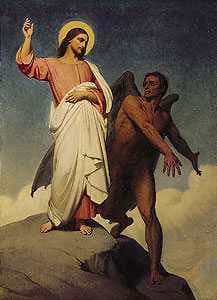
1 "Then Jesus was led by the Spirit into the wilderness to be
tempted by the devil. 2 After fasting forty days and forty nights, he was hungry.
3 The tempter came to him and said, “If you
are the Son of God, tell these stones to become bread.”
After fasting for 40 days and nights, Matthew writes in chapter 4 that Jesus was evidently hungry. Jesus is part man and God, enabling him to naturally encounter hunger. Had Jesus been provided food and water in the wilderness, the devil would have no weakness upon which to prey. Jesus defends the Lord against all three of the devil's attempts, demonstrating his faithfulness in trials of temptation. The undesirable conditions of the wilderness create weakness in the flesh, which God uses to prepare or refine us for His impending good works.
After leaving Egypt on their trek to the Promised Land, Moses and the Israelites encountered expected hunger and thirst. The Israelite people blamed God, wishing to return and die in Egypt. Exodus 16 documents:
1 "The whole Israelite community set out from Elim and came to the
Desert of Sin, which is between Elim and Sinai, on the fifteenth day of the
second month after they had come out of Egypt. 2 In the desert the whole community grumbled against Moses and Aaron. 3 The Israelites said to them,
“If only we had died by the Lord’s hand in Egypt! There we sat around pots of meat
and ate all the food we wanted, but you have brought us out into this desert
to starve this entire assembly to death.”
4 Then the Lord said to Moses, “I will rain down bread from heaven for you.
The people are to go out each day and gather enough for that day.
In this way I will test them and see whether they will follow
my instructions. 5 On the sixth day they are to prepare what they
bring in, and that is to be twice as much as they gather on the other days.”
Only a fraction into their 40 year journey, the Israelites face the temptation of the wilderness; however, God demonstrates His promise to never abandon His people by reassuring that bread will come down to nourish them. Similarly, Numbers 20 tells of God providing the people with water from a rock that Moses strikes. As the Israelites are surrounded by sin and vacancy, God remains among them. While the wilderness is a desert in both examples I shared, it refers more closely to an uninhabitable land that God strategically uses to invoke faithfulness and trust.
WHAT IS A "WILDERNESS SEASON"?
Being drawn into the wilderness by God is not only an ancient, biblical concept. In our lives, God may draw us into seasons of the wilderness to prepare or refine us to serve His kingdom. During this time, we set apart the white-noise of the everyday to hear God clearly, learning to trust in His every word. The wilderness is a time of great vulnerability, often characterized by heavy burden, abandonment, or confusion. While we are tempted to find the easiest solution to escape this misery, God intends for us to lean on Him for support. As He promises, He remains among us during the trial in subtle but substantial ways.
I really enjoy being surrounded by family and friends of faith. The conversation with my mom this morning uncovered a lack of knowledge that I was unaware existed. Even when we assume to know the answer- like what the wilderness looks like- it turns out that our faith conceals far deeper significance. In this way, rediscovering my Catholic roots invigorates me; there is always something to learn, share, and discuss. As a control freak, I thrive from knowing and leading everything around me, but times like this humble me. Only our God is truly omniscient, and we, as humans in the flesh, are simply incapable of knowing all of His wisdom. Learning to accept this reality challenges me to reevaluate if controlling every situation is worth the hassle... uncovering something new can be just as fulfilling.

Comments
Post a Comment